
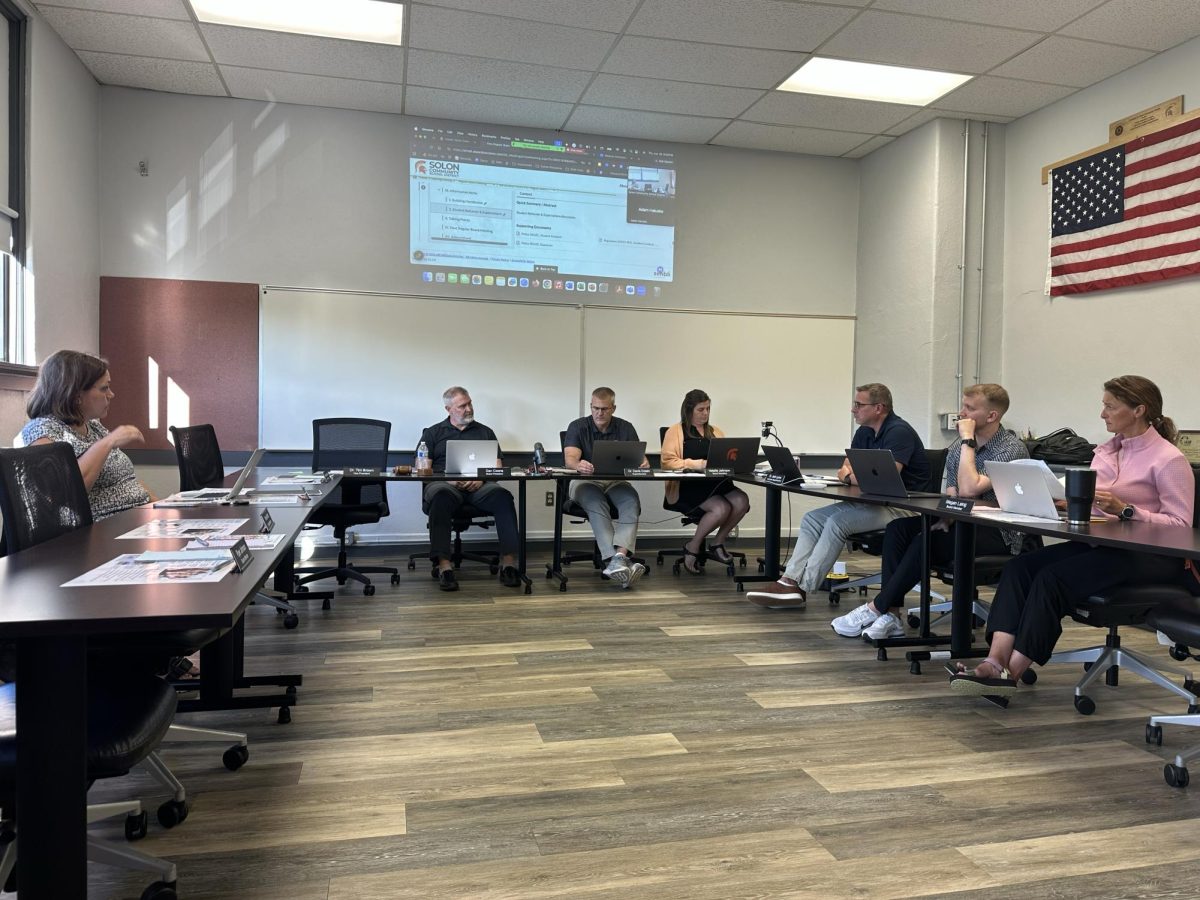
During its regular monthly meeting on Thursday, June 18, the Solon Community School District’s (SCSD’s) Board of Education approved a revised version of its special education (SPED) delivery plan. The district will begin applying these changes during academic year 2026-27.
According to Superintendent Davis Eidahl, the plan is renewed every five years to ensure the district is effectively fulfilling the accommodative and educational needs of all students. He said although the former plan was effective overall at addressing these needs, the district is constantly striving for improvement.
“I think we had — before [the one] we just adopted — a great special education department and delivery plan,” he said. “But from really looking deep down: how can we make it better, and how can we take the next step and grow? That’s our big plan.”
The latest version of the district’s SPED delivery plan was developed by a committee consisting of special education teachers, general education teachers, parents of individuals eligible for these services, Area Education Agency (AEA) representatives, and district administrators. Prior to it being considered by the school board, the plan was approved by the AEA and made available for public comment as well.
Josh Lyons, associate superintendent and special education director, was one of twelve individuals who served on the development committee. He said as a result of feedback from and discussions with the AEA, the committee became primarily focused on adjusting the plan’s language to make it more descriptive; that is, as opposed to making drastic changes.
“It was really more about trying to better describe what our current continuum of services look like, as well as adding a visual in our plan just to be able to help people really see that,” he said.
According to the delivery plan, the district’s goal is to provide eligible students with services in the least restrictive environment possible. This means opportunities to interact with and learn in the same classroom as peers without disabilities are maximized.
Each eligible student’s individual education plan (IEP) tends to heavily include elements outlined in one of five categories lined upon the continuum of services.
On the least restrictive end lie consultative support in the general education setting, specially designed instruction in the general education setting, and specially designed instruction in the special education setting. These three categories entail special and general education teachers collaborating to make accommodations for students to engage with the general curriculum alongside peers.
On the more restrictive end of the continuum, eligible students who have not received a regular high school diploma may engage in 4+ transition services and programming, which are intended to provide instruction in areas beyond the general curriculum. The final category — selfcontained and alternative setting — is the most restrictive, although the ultimate goal is to eventually transition students to a less restrictive environment.
Although this updated plan is more specific about the services offered by the district, Lyons emphasized it is still broad enough to allow for flexibility in meeting student needs. For instance, these five categories that line the district’s continuum of SPED services are not mutually exclusive, and a student’s IEP may employ a combination of supports.
“When we talk about services, supports, accommodations, modifications, and adaptations for students, it really is an IEP team decision in how we determine what those services look like,” he said.
In the revising process, Lyons said the development committee also focused on expanding the plan’s description of how caseloads for teachers are determined. He said providing specialized services to students requires having enough staff with the proper knowledge and available time to do so.
“As students become eligible for special education, we need to ensure that we have enough service providers — so special education teachers — to provide those services in an efficient way,” he said.
Moving forward with this new five-year plan, the board hopes to close any and all education gaps between the district’s students through the continuum of services.
These SPED services are available to all students in the district aged 3 to 21. For more information about the revised SPED delivery plan and the services available to students, visit the Solon CSD website (www.solon.k12.ia.us/ page/special-education) or reach out to Lyons at [email protected].