
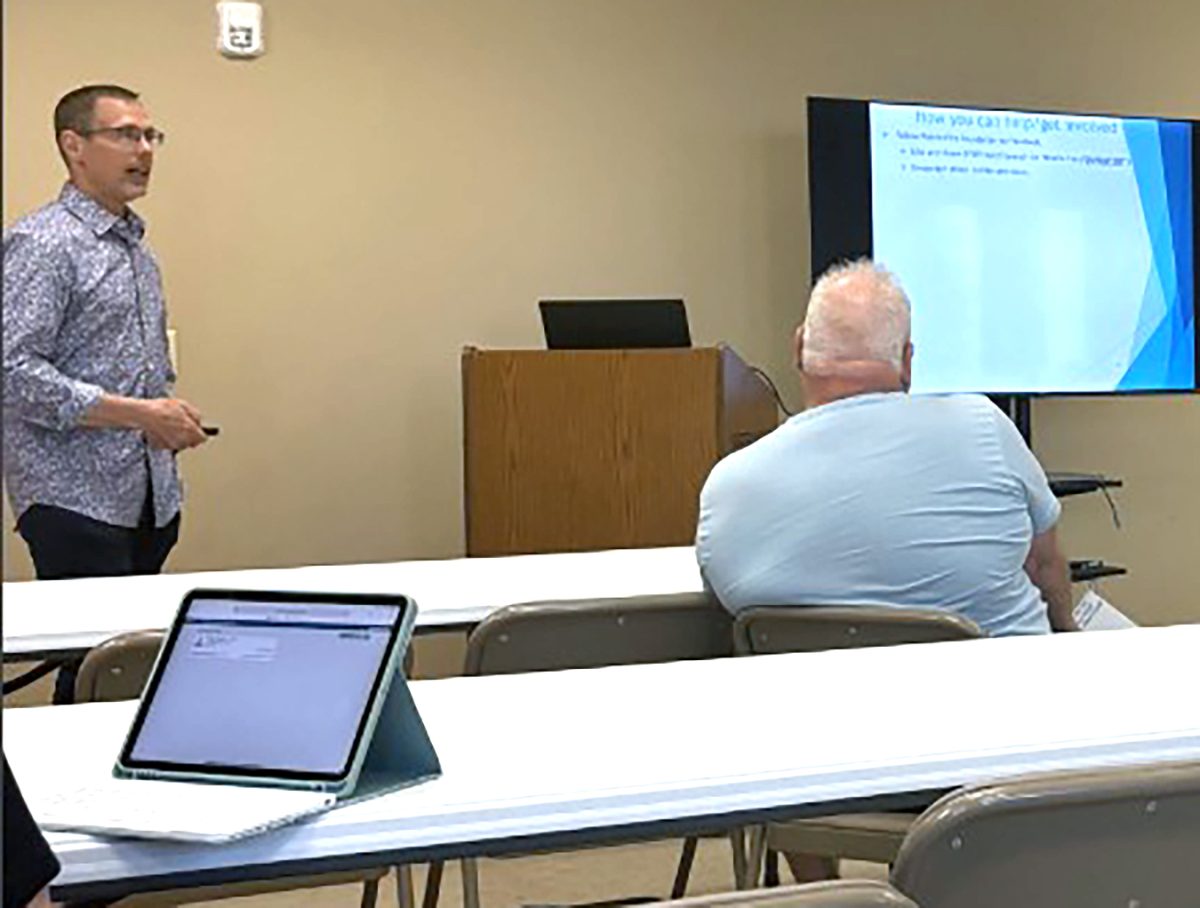
Residents gathered at St. Mary Catholic Church on Thursday, May 28, for a presentation on global water access issues as Michael “Mike” Stein of the Prairie Fire Foundation shared his experiences raising awareness and funding clean water projects in Tanzania and Honduras through the Sister Water Project and other groups.
Stein outlined the scale of the global water crisis, noting that at least 314 million people in Africa alone lack access to safe drinking water. Stein said the issue has motivated years of fundraising and advocacy through his “I Run for Water” campaign, which combines distance running with efforts to support water infrastructure projects in underserved communities.
“Water is life,” Stein told attendees as he discussed the challenges faced by communities that lack reliable access to safe drinking water.
Stein explained that the Sister Water Project was established in 2006 by the Dubuque Franciscans after studying global water access issues and identifying communities in need of reliable sources of clean water. The organization initially sought to raise $42,000 to fund water projects in Tanzania and Honduras. By April 2007, the original goal had been met, resulting in nine water collection tanks being funded and constructed in Tanzania while 30 volunteers traveled to Honduras later that year to assist with water infrastructure projects.
The organization’s work in Tanzania is conducted through a partnership with Safe Water for Life and Dignity. Local volunteers help identify villages with the greatest need for clean water before projects are approved and constructed.
Stein shared photos and stories from several trips to Tanzania, where communities often rely on open wells or distant water sources. In one village, families used an uncovered well where each household lowered its own bucket into the water. According to Stein, this practice increased the risk of contamination through repeated contact with multiple buckets and exposed the water supply to debris, animals, and disease.
To address those issues, communities work with the Sister Water Project to construct deeper, protected wells. Concrete rings approximately one meter deep are stacked until a reliable water source is reached. Stein said most wells require seven to nine rings before reaching groundwater.
The impact of those projects extends beyond access to drinking water. Stein said communities often see dramatic health improvements shortly after receiving clean water. Stein noted that “within six months of having access to clean water, gastrointestinal diseases are almost completely gone,” while illnesses such as typhoid fever, cholera and diarrhea decline significantly.
Access to clean water also affects education. According to Stein, “within two weeks of having access to clean water, children’s performance in school increases,” as students spend less time collecting water and fewer days recovering from illness.
Stein emphasized that even small donations can have a lasting impact, telling attendees that “five dollars provides water for someone for life.”
As of April 2026, the Sister Water Project had supported more than 629 well projects in Tanzania, serving an estimated 627,213 people. Stein noted that the average cost works out to approximately $5.33 per person served.
The presentation also highlighted the organization’s growing work in Honduras. Stein said approximately 9.6 million people live in Honduras, with an estimated 1.5 million lacking access to clean and accessible water resources.
“Children in Honduras have to walk many miles every day to get water that makes them sick and keeps them locked in a cycle of illness,” Stein said.
One example shared during the presentation was the village of Mejocote. “The village of Mejocote worked for years to bring water to their village,” Stein shared, where the nearest reliable water source was approximately 18 miles away. The Sister Water Project helped provide pipes, supplies and volunteer labor to connect the community with a dependable water source.
Stein said health outcomes in Honduras mirror those seen in Tanzania.
Following the completion of water projects, rates of parasites, diarrhea and other water-related illnesses decline significantly, improving quality of life throughout the community.
As of January 2026, the organization reported funding 75 water projects in Honduras. Of those, 61 had been completed and 14 remained in progress. The projects were serving approximately 71,312 people.
Stein also touched on water quality concerns closer to home. Stein discussed nitrate contamination in Iowa’s water supply, noting that Iowa has the second-highest cancer rates in the nation and one of the fastest-growing incidences of cancer. He referenced research linking nitrate exposure to increased risks for certain cancers, including colorectal cancer, and encouraged residents, particularly those using private wells, to test their water regularly.
For homeowners concerned about water quality, Stein recommended annual testing and discussed reverse osmosis filtration systems as one option for reducing contaminants. He noted that private well testing is available through the Iowa State Hygienic Laboratory and encouraged residents to monitor both private and public water sources.
Looking ahead, Stein said he plans to continue expanding his fundraising efforts. He reported raising approximately $20,000 in 2025 and has set a goal of raising $50,000 in 2026. Future fundraising efforts include participation in endurance running events through his “I Run for Water” initiative, including a half marathon in Emmetsburg.
Stein concluded by encouraging attendees to support the Prairie Fire Foundation through donations, volunteer work, social media outreach and participation in fundraising events. He emphasized that relatively small contributions can have a lasting impact, helping communities gain access to safe water, improved health and greater educational opportunities.
Stein’s presentation ended with a quote that reflected the mission behind the organization’s work: “Today is the beginning of a new day. I can waste it or grow in its service to others.”