
Home to five sites on the National Register of Historic Places — Stone Academy, Buresh Farm, Cottage at Rock and Dubuque Streets, Henyon-Kasper-Duffy Barn, and Saints Peter and Paul Chapel — Solon is rich with historical sites, buildings, and memories.
But as Solon continues to expand, residents and preservationists say protecting history is becoming increasingly important.
The town’s population has surged in recent decades, growing 73% from 2000 to 2010 and another 48% from 2010 to 2020, raising concerns that the 3,152-person town may risk losing pieces of its past unless preservation efforts can keep up with development.
For 91-year-old Sandra “Sandy” Hanson, preserving Solon’s past has been decades in the making.
Formerly an antiques dealer, Hanson has always been surrounded by and interested in history.
Vintage benches, cabinets, and antique decor fill her home. She sits in a plush, brown armchair, with a crossword puzzle and a few books lying on the footrest in front. She intently shares stories of Solon’s past — its naming, landmarks, plaques.
“We realized that Solon was named not from these Greek or Roman legislators and Spartans but from the people — the Langworthy’s — who plowed Dillon’s Furrow,” Hanson explained. “Who would know that it came from the 1800s oxen plows?”
Lyman Dillon plowed a 100-mile furrow from Iowa City to Dubuque in 1839, according to the City of Cascade. The Langworthy brothers worked as contractors on the route. Some Solon residents believe Solon M. Langworthy — an early Iowa settler — inspired the town’s naming.
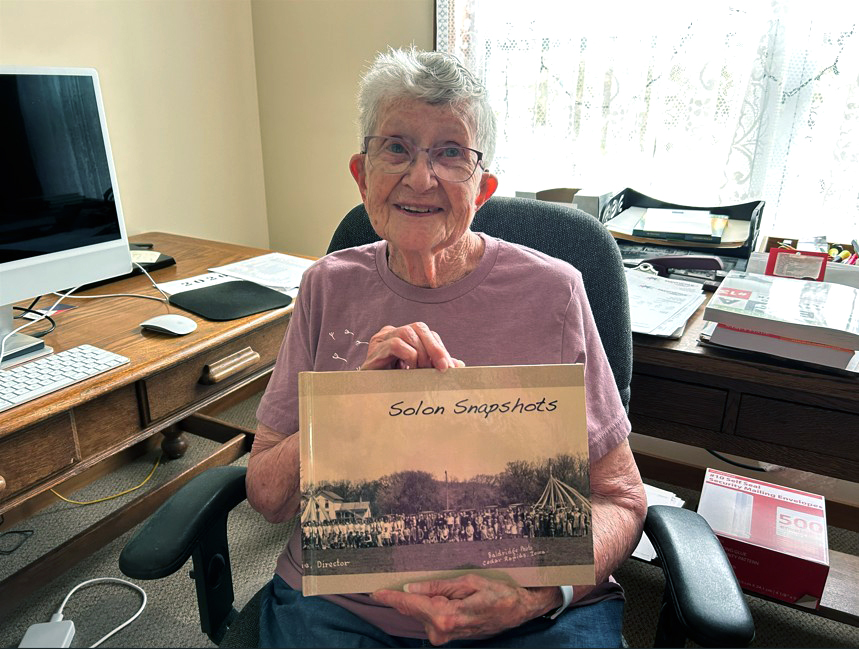
Hanson, dubbed Solon’s “history champion” by the Solon Public Library, has spent years organizing hundreds of photographs and newspapers — some dating back to 1893 — that depict the city’s history. She first became involved in preservation work as a volunteer at the library after discovering countless boxes containing old papers and photographs.
Determined to keep Solon’s history alive, Hanson encouraged residents to contribute their personal images and compiled archived photographs into a book, Solon Snapshots, that was published in 2012.
“I’ve been around history a long time, so I think we’ve got to preserve it, keep it going,” Hanson said. “Small towns have their own special footprint.”
Yet, despite her efforts, Hanson worries about what will happen to the materials she has spent years organizing and protecting. Her concerns reflect a broader challenge facing Solon: Who will take responsibility for maintaining the town’s history as longtime residents step back and new development moves in?
Until 2023, Solon didn’t have a group dedicated to historic preservation, as the town’s Historical Preservation Commission was inactive.
Recognizing a need to better preserve and organize the past, several residents gathered to establish the Solon Historical Foundation, hoping to protect historic sites, artifacts, and records in Solon and surrounding townships.
Executive Director Cathy Cilek said the mission of the foundation is that it aims to create community identity and interaction through historical preservation.
“[Preservation] adds identity to the community. It creates interaction. It helps keep the stories alive,” Cilek said. “It helps us to educate and involve not just the new generations, but incoming families and so forth, which is happening so much these days.”
Currently, the foundation’s main project is the restoration of the Stone Academy — Iowa’s oldest one-room schoolhouse built in 1842.
The group is working to repair the building, starting with exterior repairs such as replacing the roof and restoring the stone structure. The foundation also plans to apply for a $50,000 state grant in May to assist with costs.
Additionally, the group is determined to expand its efforts across Solon. Cilek shared that the foundation is in contact with owners and leaders of historically significant buildings in the community to determine whether they need assistance with preservation, registration, or grant support.
Preservation work in small towns often comes with challenges. Funding can be limited, the process of applying for grants can be time-consuming, and community awareness can be low.
The work of repairing historical buildings also brings forward additional hurdles. With the Stone Academy, the schoolhouse has no usable electricity, heat, or running water, and gaps in the exterior have let in mice and weather. Specialized work, such as finding an expert to recreate the original technique of applying plaster directly to the stone walls, can be expensive and difficult to locate.
Yet, Cilek said one of the biggest challenges is helping residents understand the value of registering their historic properties and that it does not always come with hefty or burdensome costs.
“There’s money available, grant money that can be pursued,” she said. “You’re not stuck with anything but getting it registered is really important.”
Across Johnson County, communities are facing similar questions about what to preserve and how to do it.
Alexandra McKendree, executive director of the Johnson County Historical Society, said the organization often works as a resource for smaller communities navigating preservation efforts.
“We can’t necessarily take on every project,” McKendree said. “But we can provide technical assistance, help guide people through grants, and connect them with the right resources.”
She said interest in preservation has been growing as well — particularly in smaller towns.
“I’ve seen a resurgence in our small towns,” she said. “Communities are realizing, ‘We need to save this.’”
One nearby community taking part in preserving history is North Liberty, home to the historic Samuel and Emma A. Ranshaw House. In 2017, the town renamed Highway 965 to Ranshaw Way, honoring its past and reflecting its identity.
Still, the work can be complex and costly. Maintaining historic accuracy often requires specialized materials and labor, and failing to follow preservation guidelines can limit access to funding opportunities.
Rapid growth can also complicate efforts, as new development may surround or threaten historic properties.
“It can go either way,” McKendree said. “Sometimes it reminds people that it’s there. Other times, it becomes a question of what happens to it next.”
But at the center of it all, McKendree said, is community support,
“If the community doesn’t see the value in it, it’s hard to justify saving it,” she said. “Once it’s gone, it’s gone.”
Despite obstacles, local support has played a key role in communities like Solon, with the Solon Historical Foundation raising over $10,000 at a recent fundraising event for the Stone Academy.
As restoration efforts continue, the foundation hopes the Stone Academy will become more than a historic building — but a place where the community can gather, learn, and stay connected to its past.
City Administrator Cami Rasmussen emphasized the importance of remembering local history while hoping for future collaboration between organizations and the city in preserving its legacy.
“Every community has a lot to lose if we don’t continue to tell our story, and our story really starts with the people and all of the things that they’ve done to help Solon become Solon,” Rasmussen said.
Still in its early stages, the foundation operates with a small board and no formal volunteer program. Cilek said gathering volunteer support will be a next step as the project continues, especially for helping with site access, fundraising events, and future public hours.
Long term, Cilek said the goal is to make the Stone Academy more accessible to the public and potential community events.
For now, the focus remains on preserving local heritage — one stone at a time — ensuring the Stone Academy, other historic sites, and the stories tied to them continue standing for generations to come in a town that is still changing.
Madison Schuler was a student in the UI Iowa Community News class this spring.