
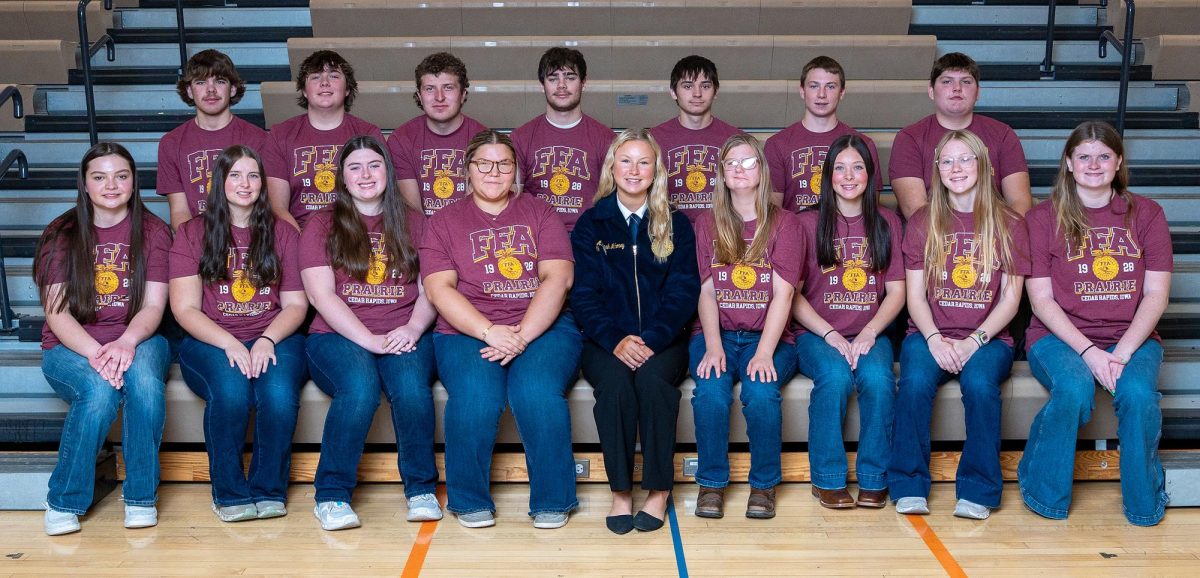
CEDAR RAPIDS — As the agricultural field continues to evolve with various new technology and career opportunities, Solon students interested in the field are able to get hands-on exposure through the recent partnership with the Cedar Rapids Prairie agriculture program.
Because the Solon Community School District does not currently offer its own agriculture program, students are able to participate in Prairie’s agriculture classes and FFA chapter through a shared program between the two districts. This collaboration gives Solon students the opportunity to access advanced agriculture curriculum and gain leadership opportunities in FFA.
The Prairie agriculture program includes around 268 students ranging from grades nine through 12 for the 2025–26 school year. Since the program started six years ago, it has quickly expanded and is now currently the second largest agriculture program in the state of Iowa.
Prairie agriculture teacher and FFA advisor Kristy Thomann said the goal of the program is to help students understand the large range of opportunities within the field of agriculture.
“My goal as a teacher is to keep educating my students about how agriculture goes beyond living and working on a farm,” Thomann said.
Students in the program study a wide variety of agricultural topics, such as plant and animal anatomy, crop production, soil science, natural resources, irrigation, water quality and agricultural financial practices.
The program offers several different courses that introduce students to a multitude of industry aspects. Specific classes include Introduction to Agriculture, Animal Science, Plant Science, Advanced Animal Science, and Agricultural Business. Agronomy is also offered with dual credit through Kirkwood Community College. Ag in Industry is a senior internship capstone class.
Thomann teaches the introductory classes while fellow agriculture teacher and FFA advisor Laura Brecht is in charge of the upper level courses.
Agriculture classes combine classroom learning with in-person experiences that allow students to apply what they learn. Thomann said the program emphasizes building foundational knowledge before students move into the more practical activities.
“The way I balance lectures and labs is that I first take the time to introduce important vocabulary and background information that is necessary to understand prior to applying it,” Thomann said. “Once students have been given that information, they then can take what they have learned and apply it into a real world setting through hands-on activities.”
In advanced classes, students work directly with plants, animals and agricultural technology. Plant Science students grow flowers and produce in the school greenhouse for Prairie’s annual plant sale in May, managing the care, watering, and growth schedule for the plants throughout the growing process.
Students in Advanced Animal Science complete a semester long project raising broiler chickens beginning when the chicks hatch. Each student helps supervise, feed, and care for the chickens before learning the butchering process at the end of the project. Students then are able to take home the processed chicken.
The program’s dual credit Agronomy class also allows students to explore crop production through the FFA chapter’s test plot, giving them exposure to the harvest side of agriculture.
Even introductory courses include hands-on technology. Freshmen in Introduction to Agriculture use sensor tools to test environmental factors such as pH levels while studying natural resources, plants, and animals.
The program follows the Three Circle Model of Agricultural Education, which includes classroom instruction, FFA participation, and supervised agricultural experiences known as SAEs.
Through SAEs, students complete monthly journal entries connecting their everyday activities and interests back to agriculture.
“Most students who are in our program do not have an agriculture background, so these projects help our students understand how their activities, jobs and hobbies outside of school connect back to agriculture,” Thomann said.
Students enrolled in agriculture classes are automatically members of the Prairie FFA chapter through its affiliation with the Iowa FFA Association. This allows them to participate in a variety of competitions and leadership opportunities.
FFA contests are divided into Leadership Development Events and Career Development Events. Leadership competitions focus on skills such as public speaking, parliamentary procedure, and job interviews, while career competitions involve more hands-on experiences connected to agricultural career paths.
Examples of Career Development Events include livestock judging, marketing, floriculture, and soils judging.
“These contests have really allowed our students to get hands-on experience with agriculture, all while being in a competitive environment,” Thomann said.
Beyond agriculture specific knowledge, students gain skills that translate into many career fields.
“Beyond farming, students are able to gain skills related to critical thinking, problem solving, communication, collaboration and responsibility,” Thomann said. “Many of the industry partners associated with our chapter have mentioned how Ag students and FFA members are some of the most prepared and well-spoken candidates when it comes to competing in the job market.”
Thomann added that the future of agriculture will continue to expand as technology becomes more integrated into the industry.
“We are fortunate to exist in a time where technology has advanced greatly, especially as we exist in a world with a record high population,” Thomann said. “Our students have more opportunities to explore technology and engineering careers, such as the use of GPS in precision farming.”
After students finish the program, many continue studying agriculture in college fields such as agronomy, agricultural business or agricultural studies. Others pursue careers in related industries or skilled trades.
Still, Thomann said the most important lesson students take away is understanding how agriculture connects to everyday life and the future of the global food system.
“I always tell my students that as long as we have people on Earth, agriculture is here to stay and will always be hiring,” she said.