
According to a review by the Grant Wood Area Education Agency, the Solon Community School District (SCSD) is positioned as a champion of special education services across the state, ranking above average in Individualized Education Program (IEP) attendance numbers, graduation rates, and staff and family connections.
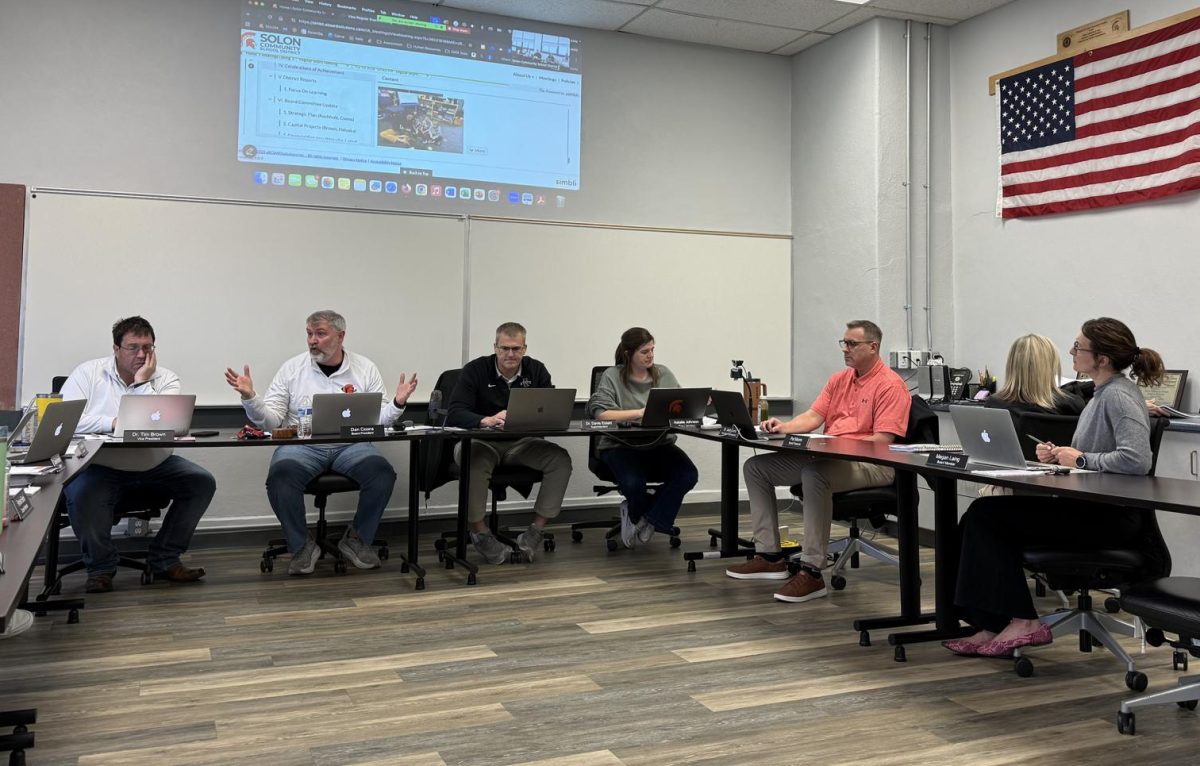
At the March 10 school board meeting, Josh Lyons, associate superintendent of teaching and learning, gave a preliminary overview of the study’s findings. He plans to provide an additional, more detailed overview at a future school board meeting.
“They came back with quite a bit of information, which was really good,” said Lyons.
The district’s IEP graduation rate of 76.9%, which is above the state average of 70.3%, provided quantitative data to back the district’s identified strengths in effective transition procedures between grade levels, supported and connected families of special needs students, and responsive leadership to parent and staff concerns.
Of students with IEPs, 84% spend 80% or more of their day in an integrated setting, allowing the district to efficiently follow organized timelines within the program.
The study was conducted through voluntary stakeholder focus group surveys, collecting observational data from teachers, high school students, and parents. Numeric data was collected through attendance rates, assessment results, enrollment and graduation rates, and behavior pattern referrals.
Dan Coons, president of the school board, commended Lyons and Grant Wood AEA for taking the initiative to assess and report the strengths and weaknesses of SCSD’s special needs programs.
“When you have the opportunity to evaluate yourself — when you’re not made to evaluate yourself — it can be humbling at times, but it keeps us ahead of the curve and keeps us out of trouble,” said Coons. He emphasized the district’s interest in conducting preventative studies rather than reacting to issues after the fact.
The December 2025 program review aimed to measure the scope of seven sectors of the district’s preschool through 12th-grade special education programs: Equitable access, Individuals with Disabilities Education Act (IDEA) compliance, student performance and post-secondary achievement, delivery of services, teaching capacity, family engagement, and program leadership supervision.
Each of the seven measured scopes were ranked as a high, medium, or low priority. According to Lyons, student performance and post-secondary achievement, delivery of services, and program leadership supervision were the three highest priorities for the program review.
“Some of these big four [areas that need improvement] — there are other more intricate details that that they provided in terms of some other areas that we need to focus on,” said Lyons, acknowledging future growth opportunities for the district. “There were some ideas that have already percolated through just my observations and engagement.”
The big four areas of growth for the district include equitable access to elective courses, continued data gathering to adjust designed course instruction, integration of special needs resources in non-IEP classrooms, and standard district-wide supervision of IEP practices.
“Really try to look at what opportunities we’re providing those kids and ensuring they have access to all those opportunities, consistent use of instructional decision-making data for adjustments, especially designed instruction,” Lyons outlined as areas to improve on.
With recent changes in state and AEA monitoring of special education programs, the district acknowledged its increased role in program oversight. As the district continues to grow, Lyons hopes to continue providing general supervision to ensure policies, procedures, and resources are adequately prioritized for special needs students.
The board outlined next steps of identifying short and long-term goals for IEP program improvement and communicating those with district staff in the fourth quarter of the year.
Allisa Pandit is a student in the UI Community News class.