
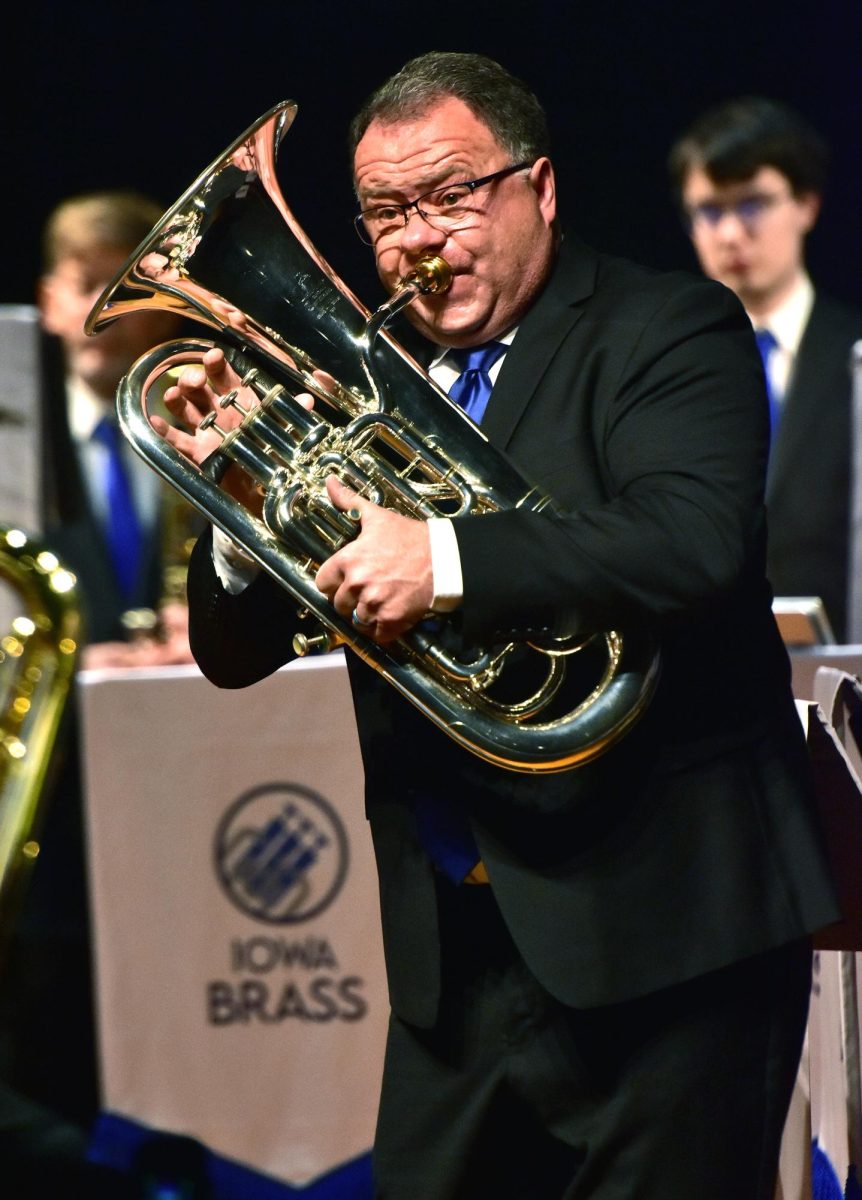
Originally known as the Eastern Iowa Brass Band from 1986 through 2020, the ensemble rebranded during the pandemic shutdown and returned in 2021 as Iowa Brass. In 2026, the band will celebrate its 40th anniversary, a milestone that reflects not just longevity, but the enduring power of community-driven art.
Euphonium player Todd Bransky’s connection to the Eastern Iowa ensemble began almost by chance. After graduating from college, he moved to Solon in August 1988 to begin teaching instrumental music for grades seven through 12.
“Although I had heard of British-style brass bands, I had never actually heard one or seen one perform,” Bransky said. “Shortly after moving here, a Solon resident invited me to come play with the Eastern Iowa Brass Band, Iowa’s only British-style brass band at the time.”
Formed in 1986 and rehearsing weekly in Mount Vernon, the Eastern Iowa Brass Band immediately became part of Bransky’s life. What started as a simple invitation turned into a lifelong commitment.
Bransky says that from its earliest days, competition has always been central to the ensemble’s identity. The band began competing nationally at the North American Brass Band Association Championships in 1986, and over nearly four decades has earned numerous top-three finishes. While its roots are firmly in Solon, performing on a national stage has always been part of the band’s journey and goal.
One of Bransky’s favorite memories from this past year did not happen under stage lights, but in a hotel atrium. While attending the U.S. Masters Brass Band Championship in Kansas City, the band stayed at the Embassy Suites by Hilton Kansas City International Airport, an eight-story building with balconies overlooking a central atrium.
“We had already memorized the piece for the competition and had performed it surrounding the audience in the concert hall,” Bransky said. “Looking at that atrium, it felt like the perfect space to share the piece one more time. We lined up around the entire fourth-floor balcony and played for anyone in the atrium, lobby, hallways, or lounge below. Several people captured it on video, and it ended up being one of those rare, goosebump moments that none of us will forget.”
Despite the beauty of the songs, the competition repertoire itself presented significant challenges. Bransky said that Vitae Aeternum by Paul Lovatt-Cooper demanded fast fingerings, multiple tonguing, memorization and exposed unison passages that required methodical practice and countless hours with a metronome. Lux Aurumque, however, tested the band in a different way.
“It had to be fully memorized, played extremely softly and precisely, and performed while standing next to audience members,” Bransky explained. “Balancing, blending, and staying in tune while being physically separated from other players across the auditorium, all at a very soft dynamic, was incredibly difficult. It requires intense focus on entrances, releases, and pitch when you are that exposed.”
Balancing this intense level of preparation with daily life is an ongoing challenge for the ensemble. Many members have children with school activities, while others are full-time music educators with evening and weekend responsibilities of their own.
“For most of us, the common thread is passion,” Bransky said. “Because we care so deeply about playing at this level, we make time for it while understanding that family and work always come first. When needed, we rely on substitutes. Scheduling concerts and major events 6 to 18 months in advance also helps members plan and balance their personal and professional lives alongside their commitment to Iowa Brass.”
Rehearsals at the Solon Community Center reflect that commitment. With only two hours per week and as few as two rehearsals before some performances, Bransky says that focus is essential. While rehearsals can be intense, camaraderie plays an equally important role.
“We have a few members who know exactly when to lighten the mood,” added Bransky. “Steve Kenny, in particular, has a great sense for when a well-timed comment can bring a smile or a laugh and reset the room.”
Representing Iowa on a national stage remains a source of pride for the band. Members come from smaller communities, a contrast to many competing ensembles based in larger cities such as Chicago, Detroit or Houston.
“Iowa Brass is not just about concerts,” Bransky said. “It is about volunteers, local venues, shared traditions, and giving people something to feel proud of in their community. When arts programs fade, towns lose more than music. They lose gathering places, mentorship, and continuity between generations. Community-based groups like ours prove that high-quality arts do not have to be distant or exclusive. They can live right here, shaped by the people who show up, support one another, and care deeply about where they live.”