
IOWA CITY — The non-metro (outside of Iowa City, Coralville, University Heights, Tiffin, and North Liberty) population in Johnson County has been growing steadily for 15 years, and more than 700 new households are anticipated over the next decade.
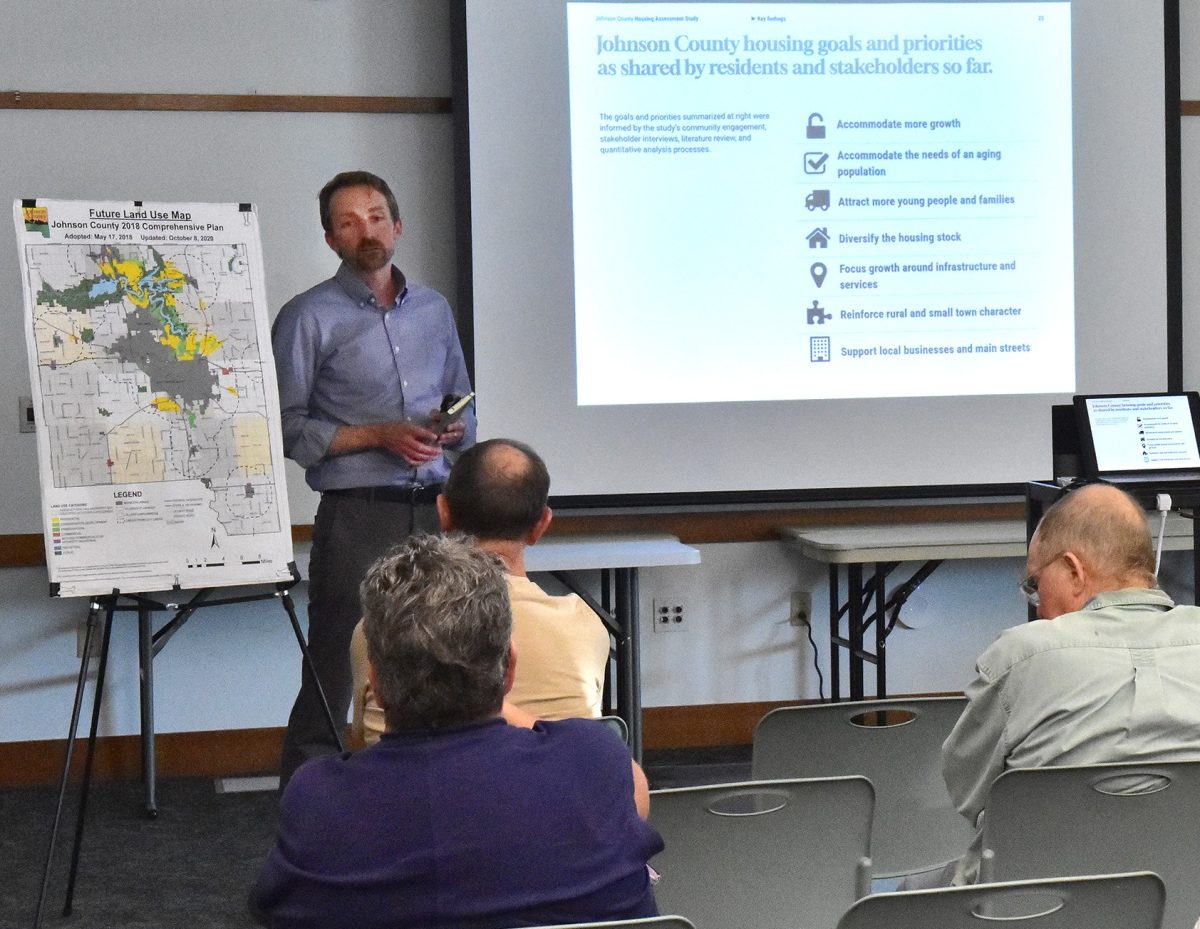
So says a study by CommunityScale, a consulting firm specializing in urban planning based in Boston, in their final report studying housing in Johnson County. The study, funded by Johnson County, was conducted this fall with key findings and recommendations based on more than 35 hours of engagement with nearly 120 residents, stakeholders, elected officials, and local government staff in addition to processing 90 surveys. The study focused on the unincorporated areas of Johnson County and the cities of Hills, Lone Tree, Oxford, Shueyville, Solon, and Swisher. Concerns related to manufactured housing (mobile home) parks in the county were also addressed in the study and discussions.
During a September public input session in Solon Sarah Thompson, Economic Development Coordinator with Johnson County Planning, Development, and Sustainability (PDS) explained planning for the study, the first to focus exclusively on the rural communities and unincorporated areas, began a few years ago.
“We talked about the need for figuring out what’s going on out in the rural communities and how they’re changing and growing. It’s usually the metro and they might tag on one of the smaller communities. So, we really wanted to focus on the communities that weren’t part of the metro, and also the manufactured housing communities, even if they are in the metro, because they also don’t get counted a lot when the metro does,” she said.
As stated the non-metro population is projected to continue to grow over the next decade from 10,210 households in 2010 to a forecast of 12,033 by 2035. The number of households, while generally continuing in an upward trend, have had some fluctuation with a peak of 11,174 in 2015 dipping the following year before climbing again to a peak of 11,417 in 2018. 11,238 households were in the non-metro areas in 2023 with a total of 11,380 for this year.
The study noted the non-metro area’s population is aging rapidly, which could impact the projected future growth.
“The non-metro area needs to continue attracting young people and new families to keep the community sustainable in the long-term,” the study said.
In 2010 the 65+ population was 3,245 and has grown to 6,207 this year with a projected total of over 8,200 by 2035. Current trends, according to the study, show the 65+ cohort as the fastest growing segment of the population with most other age groups declining over the next decade. In contrast the 0-19 age group, at 7,553 in 2010, is projected to remain relatively steady over the time period with a forecast of 7,053 by 2035. 50-64 year olds numbered 6,176 in 2010 and are projected to decline to 5,522 while the 20-34 age group, at 3,918 in 2010, is also projected to remain steady with a forecast of 3,715 in 2035.
The study finds a large supply of owner-occupied houses in the non-metro areas but cites a lack of other alternatives such as rental units, which the study notes is typically a new household’s entry point to a community before buying a home. It also points to the 65+ population looking for opportunities to downsize while remaining in their communities – trading a larger house for a condo or townhome, as examples. The study also finds the majority of the housing stock to be single family homes with a lack of attached single family (townhomes/duplexes) or multifamily housing available. This, the study says, does not offer enough choices for middle and lower-income households who tend to prefer a wider range of housing options, including more multifamily dwellings.
Affordability is a factor, the study notes, with middle and upper incomes having more options for housing than those with lower income. And it also noted a “shrinking” of the middle-income levels while higher income levels tend to be increasing.
Overall the study finds the non-metro area will need 950 new housing units over the next decade to keep pace with the projected population growth. Additional units would be necessary to catch up with the county-wide growth that is occurring and is also projected to continue.
CommunityScale’s findings were presented to the Johnson County Board of Supervisors during their Wednesday, Nov. 12 work session. The full report can be viewed at https://communityscale.github.io/JohnsonCounty/.